Blogs

Category Archives: Expeditions

Over Guyana

By


The Essequibo River is the longest river in Guyana, and the largest river between the Orinoco and Amazon. Rising in the Acarai Mountains near the Brazil-Guyana border, the Essequibo flows to the north for 1,010 km through forest and savanna into the Atlantic Ocean.

I’m looking forward to getting back in the air and doing some more flying over Guyana! Presently in Georgetown, the capital which lies below sea level and defended from the ocean by a Dutch-built sea wall. It’s tropical, very tropical here right now and I’m guessing even hotter than Hades.

This small country, the third smallest in South America, is highly diverse, largely due to the stunning variety of topography. With Suriname, Venezuela and Brazil for neighbors it is surprising that English is the official language making travel easy. Less than 1,000,000 call Guyana home and most of those live on the thin coastal strip involved in the rice or sugar cane industries. Anything inland of the coast is known as the ‘Interior’ and a huge percentage of Guyanese have never crossed its threshold. A shame indeed as nearly 75% of the country is still intact, composed of distant and dramatic Tepuis, savannas dotted with extensive wetlands and millions of hectares of beautiful primary rainforest where jaguars can  be seen regularly!

The objective this time, after having published one successful book on the area is to show off this diversity, from the air, to wow the Guyanese and hopefully to instill a sense of pride in their country. Without that basic requirement, we believe, conservation is not possible. Working in collaboration with WWF Guyana and the Guyana Defense Force helicopter crews we have a lot of work ahead of us and I intend to post as regularly as an internet connection allows. Wish us luck!

Pete Oxford

The Pantanal – A Journal Excerpt from Pete Oxford

By


The best wildlife viewing in South America?

We are in the Pantanal, Brazil, a place very dear to us at Pete Oxford Expeditions. I was one of the first photographers to get a critical mass of professional wild jaguar images and one of the first, I believe, to have Pantanal jaguars grace the pages of National Geographic Magazine, including a pull out, double page spread and a front cover in some editions. Reneé too has been coming here for years and declares it her favorite place on the continent!

Today we returned from the river, nostalgically, along the raised Transpantaneira road towards Cuiaba. We had come primarily to watch jaguars, until fairly recently one of the hardest cats in South America to see in the wild. Everywhere other than the Pantanal the jaguar remains elusive and mostly nocturnal. We set out early every morning and from our comfortable speed boats we scour the river banks looking for the cats, training our eyes and binoculars on any little spot we think might be attractive to our quarry. We imagine ourselves in their spotted skin and ask ourselves where WE would be if we were a cat. As our eyes are trained and a visual search image develops the job becomes easier. Our success on this expedition however was unprecedented. In 9 ‘game drives’ in our speed boats, we saw 11 individual cats in 13 sightings. That’s an impressive average of nearly 1.5 jaguars per drive or about 3 per day! We watched a mother with two cubs, followed jaguars hunting at the river’s edge for kilometers, saw them leap into the water after caiman or just chill – watching us.

With heavy hearts we left our floating hotel, boarded our boat for the last time and made our way towards Porto Joffre. In a final goodbye we had an incredible sighting of a Brazilian tapir crossing the river in front of us! South America’s largest land mammal, a relative of the rhinoceros, the tapir seemed to not even notice us at all. We waited for it to reach dry land where it stopped for a drink before heading off into the bush.

Before we eventually made it to Cuiaba airport for our onward flight to our post extension at the spectacular Iquazu Falls we had some pretty cool subjects for our final 24 hours etched, back to back, on our memory cards! A tapir, hyacinth macaws, caracaras, a tamandua, crab-eating foxes, a caiman with an anaconda, an ocelot, hawks, kingfishers, owls, storks, herons, waders, capybaras and even a great potoo.

A fantastic way to leave this spectacular Brazilian wetland. Until the next time Pantanal and we can only hope we have another group that is as adventurous and fun as this one was. See you all soon for another Big Cat reunion!

Cheers,

Pete Oxford

King of the Jungle? Maybe not for long!

By


Lion numbers are now down to a tenth of where they were 35 years ago. With only 20,000 left in the wild, are we going to sit back and watch them go down the same path as the tigers? From 100,000 in the1900′s, to less than 4,000 in the 1970′s. Today the move in the U.S.A to Protect African Lions Under Endangered Species Act is a step forward but not nearly enough to save them in the long term. Lions in Central and West Africa will be listed as endangered, but in southern and East Africa they will be classified as threatened. Trophies could still be imported from nations where lions are listed as threatened — as long as they meet the standards set under the special rule and the animals were killed legally.

Cecil was not the first male lion to suffer the fate when straying outside of a protected area and falling prey to a hunter. Thanks to social media it finally got the world’s attention. Two years running when we visited Hwangi NP in Zimbabwe, we learned that the dominant male we had photographed the previous year had since been hunted. This has been an ongoing problem in South Africa too.

While I was sitting in the departure lounge in OR Tambo Airport, Johannesburg a few months ago, I was sick to my stomach listening to hunters recall their exciting adventures while visiting my country. “And while we were waiting (probably at a baited site or waterhole) a hyena came in so we shot that too…”

Man is living outside the laws of nature with trophy hunting and always going for the prime individuals, but hunting is only a small part of the equation in the demise of the lions.

It takes years for a fragmented lion population – either from hunting, contraception or miss management to establish themselves as a functioning pride. Lions living in small, fenced reserves, who regularly come in contact with other lions do not always behave the same as those that have more space to roam. They change between groups frequently. They don’t always kill the cubs belonging to other lionesses. Many of these reserves don’t have hyenas or nearly enough of them to help maintain lion numbers either. Lions eat a lot! Small reserves don’t always have the numbers of plains game to feed them. Some of these excess old males land up on canned hunting farms.

Pete and I lived in a reserve in South Africa for 2 years and lion management was an eye-opener to us. It was horrific to me to learn how casually this is undertaken. No science behind who dies or who gets moved and basically they’ll ship them off to who ever will take them. There are reserves that are culling lions. Believe it or not – it is easier to cull a lion than to obtain a permit to relocate it. With a species now listed as endangered – how can we even consider culling healthy lions. In South Africa’s Kruger National Park (KNP) – our biggest park – tests show that both antibodies to the viruses that cause feline Aids (Feline immunodeficiency virus or FIV) and the bacterium (Mycobacterium bovis) that causes bovine tuberculosis are present in their lions. KNP is home to about 2,000 lions, basically a tenth of the lions left in the wild and potentially they are all sick! Again, I ask myself – how can it be possible that we are allowed to cull healthy lions in other areas? The alternative is contraception. But after several years on contraception the females become sterile so that is not the answer either.

The range of lions has shrunk. There is a move to repopulate lions into areas where they have been hunted out.

In 2013 we photographed the relocation of 4 lions to Malawi… One died in the airplane but the others are now doing well in their new home and have bred.

This year 7 lions were successfully trans-located to Akagera National Park in Rwanda. The cost of relocating lions is enormous but worth it. We must persist and facilitate this.

We are at a point with world lion numbers where every single one counts. We have also been fortunate to see the Asiatic lions in the Gir forest of India. Their numbers are so low they are barely a viable population but they do know every animal. With African lions we need a database of every individual in the world so they can be managed correctly. We need habitat for these animals to roam freely and severe punishments for poaching – where the end use is in Asian medicine, as well as a total ban on hunting. With today’s new protection act we are one step closer to shutting down one of the problems. With social media we all have a voice so let’s shout about it…

Anybody who is still not convinced should watch the movie Blood Lions.

“If we want to ensure that healthy lion populations continue to roam the Africa savannas and forests of India, it’s up to all of us — not just the people of Africa and India — to take action,” –Dan Ashe, director of the Fish and Wildlife Service.

With Christmas around the corner let us consider donating to a conservation organization to protect lions in place of buying presents. I would be happy to recommend some.

Reneé Bish

Alone in the forest

By


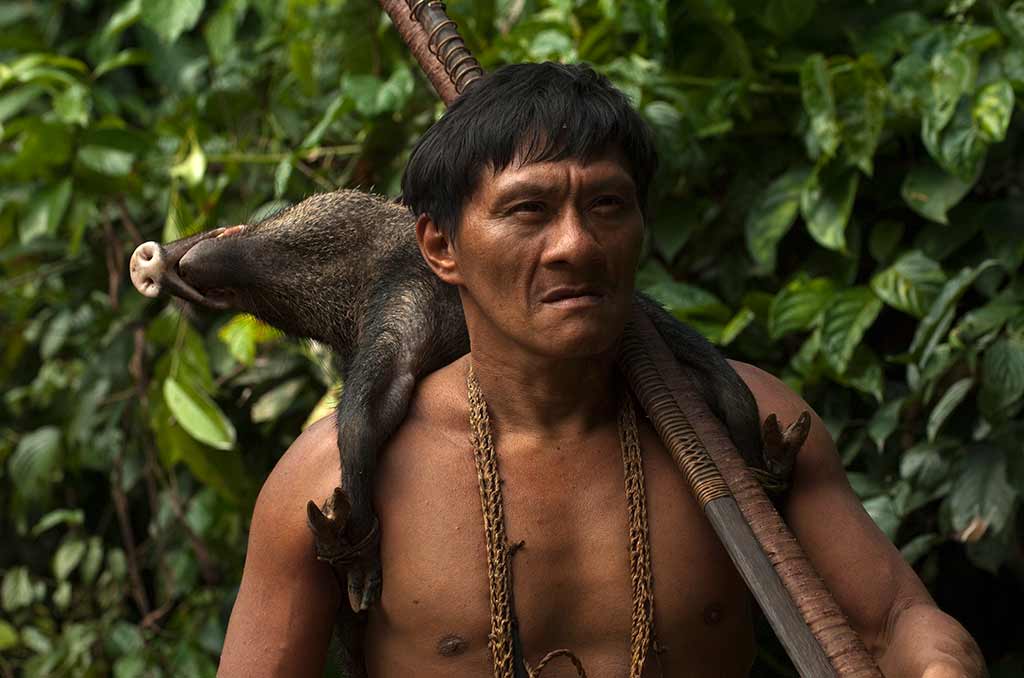
Although I have a powered paramotor at home here in Quito it is just too high and unfortunately I became quickly out of practice. So, working on a book on the Huaorani people of the Ecuadorian Rainforest, I decided to get an even bigger propeller on my back by way of a helicopter!  I needed to get into a remote village and stay with the tribe. The chopper pilot was reluctant. Indeed, the Huaorani have a fearsome reputation for spearing uninvited visitors. We had no GPS coordinates but simply a rough idea of compass bearing and distance. Flying low over a sea of rainforest canopy we saw nothing so decided to climb. The two of us searched diligently for a football pitch sized clearing. Almost at the point of having to return we finally saw what we were looking for  and made our approach to land. The pilot was screaming into my headphones that he was not going to shut down the engine and hovered with the skids just above the grass. I had to jump out and face the consequences! An elder approached, I stood my ground, and when we were face to face (more correctly his face to my chest) the pilot was ready to yank the joy stick and leave me to my fate. To my eternal relief the old warrior took off his feathered crown and placed it, in a gesture of welcome on my head! It is now a prize possession on my shelf at home.

The pilot shut down, we unloaded and the helicopter left. I was now alone (for weeks) with the Huaorani and was immediately accepted as family. And, as you can see from the second picture it was fun to be a novelty! In their culture what was theirs was mine. Everything was a pleasure being around them, the comedy, laughter, generosity and just being close to nature – immersed in primary rainforest. I had my cameras, my solar panel and my computer as trappings of the culture that I quickly felt distant from but I was unable to fully reciprocate their welcome. I slept in a tiny tent that I had brought but had to keep a small padlock on it. You see, to me a computer cable was just that and highly necessary to my work being a success, to a Huaorani it is a pretty cool thing, strong enough to be able to tie up almost anything, from dead peccaries or monkeys to hanging a blowgun on the wall of the hut! I learned so much from these people, referred to as uneducated savages by many. We could all learn from them!

Pete Oxford

Conversation Conservation

By


After giving a talk at WildSpeak in the Carnegie Institution for Science on Monday I don’t seem to have stopped talking. It was a great event, organized by the International League of Conservation Photographers (ILCP), with a hugely positive and interactive audience. What is a conservation photographer, I hear you ask? Both Theo and I are Founding Fellows of the ILCP and, along with Jami, Reneé and the rest of the League our objective is to further environmental and cultural conservation through ethical photography. We use imagery to effect change. Our belief is that an image transcends boundaries, instantaneously, across cultures, age groups and genders. An image, after all, is worth a thousand words. As conservation photographers we differentiate ourselves from being ‘simply’ wildlife photographers by using storytelling to expose threats and problems surrounding a conservation issue. In other words, clicking that shutter is not the end of the image but the beginning. Yesterday we spent the entire day at Flint Hill School in Oakton, Virginia. It was an awesome day! It was a day of incredible positivity. The students were so unbelievably well informed, already donating time, money and effort to the San Diego Zoo rhino program, or planting a native-plant butterfly garden or a host of other self-initiated projects. In this day and age of mostly negative conservation stories these students (and after 7 talks we met the entire school!) gave US hope. They inspired us to keep going, battle harder and lobby louder. I was completely refreshed by this upcoming generation who wanted a better world and already, in first grade, knew the consequences of excesses and damaged ecosystems. We talked our hearts out, offered ways we could all help and already, with feedback from the teachers, have been told that they are now living our suggestions. A totally rewarding experience!!

Pete Oxford

Reneé snorkeling with a whale shark

By


My most special experiences are in the presence of wild animals, observing their natural behavior and where they seem oblivious of me, content to let me share their world. The encounter will be forever etched in my memory but thanks anyway for being there to take the pic Pete

The biggest office in the world

By


How often do we hear people saying how lucky we are to have such an amazing job, how glamorous it must be or alternatively, when are you going to get a real job or I love travel but wish I had done more when I was younger…

There is no doubt that we try to live our lives to the fullest and we often flippantly reply to these questions with remarks such as, “Yes, we seem to have the biggest office in the world” or “why would we want a ‘real’ job?” In fact, we have often said that, while folks in the modern world, have been working and saving their entire lives in order to finally be able to travel to exotic destinations when they often should have done so previously. We, on the other hand have earned way less money but don’t need as much as we are already at those same destinations! It’s all a question of perspective.

What is seldom understood, however, is how tough the life of a wildlife photographer can be (or a trip leader for that matter!). We have sat, for example, for 12 days in a 40 degree centigrade dry stream bed in Madagascar, covered in flies before the first sighting of our subject (a fossa) and for nearly 3 months, mostly in a freezing blind, waiting for wild Iberian lynx or dangled on a rope 40 meters up in a rain forest canopy in front of a harpy eagle nest, interesting, yes, but none of it glamorous as one might be led to believe.

A real complication for us in this digital age of photography is the need to carry a computer and backup hard drives to download the images – yep we actually do have office work! The nature of our work is often in remote areas where power is an issue (thank you www.voltaicsystems.com for sorting that out!), where, even in the biggest office in the world, there is no desk or comfortable chair, where it could rain on you at any time, where inquisitive spectators may appear over your shoulder, where insects bite and are attracted to the light of the computer screen, where you often have to keep your rubber boots on, where… where…

We wouldn’t change it for the world!

Reneé Bish

Sawubona meet Reneé

By


Knock, knock… Oh that’s just me coming out of my deep closet and scarily thinking about how, what and when to blog.

Never thought massaging a turtle’s neck could be so mutually beneficial!
Having recently spent 5 weeks on the coral reefs of Belize with the MAR Alliance NGO, it was a total pleasure to both work with the local people and get to know the reef as well as we did. We ended up tagging sharks, (more to come) and turtles to try to understand more about their movements and abundance. Yes, we are a professional photographic team but at the end of the day nothing excites me more than being out there with the animals and hopefully making a difference towards protecting our planet. Believe me, camping out on the beach of an uninhabited island (apart from a ranger’s station) snorkeling in warm, crystal clear, turquoise water with nurse sharks and rays and ending the day in the company of new friends is pure heaven.

“If you want to go fast, go alone. If you want to go far, go together”.

African Proverb

Goodbye, totsiens, Hamba kahle – until next time…

Reneé Bish

Photo Power

By


A long time ago, before Pete Oxford Expeditions and over a period of many years Pete and I led dozens of trips to India. It remains our favorite country to visit. India, we always say, is a photo a minute. The colors, the people and the sheer exotic nature of the country is overwhelming. It is an assault on the senses at every level. Not knowing exactly when we might return always leaves a sense of emptiness until those tickets are bought once again giving us something to look forward to. Apart from the riot of color, design and humbleness of the people the wildlife too is exotic and abundant. In a land where the vast majority of the people are vegetarian the various cultures show great respect for their wildlife. There are no kids with catapults target practicing on little birds as one might find in Africa or South America, instead temples and shrines are built to worship rats, monkeys and birds. Some human interactions that have ingrained themselves in my memory however include our visits around the Calcutta flower market. Firstly we would always pause at a look out point where an untouchable shoe-shine man had staked out his turf.

Every visit we watched as higher castes would walk up to him, whereupon he would bow his head, not daring to make eye contact, they would pick up his brushes, use his polish and carry on their day with no remuneration to the man. On one occasion we went to the man and engaged him in conversation. He was nervous but accepted our gesture. And shined our shoes. We took his photo, paid him and left to the flower market, a veritable sea of humanity and chrysanthemums. At the flower market too we took many photos. The following year our shoe-shine man was there again. This time we approached and offered him his photo, printed and plastified to withstand the hardships of his life. The reaction was absolutely overwhelming. I swear he had never known such a joyous moment. It was an incredibly touching reaction to such a simple act. Likewise, again in the market, armed with a stack of fifty or more such images we gave each of our guests a pile of photos. The mission was to distribute them to their likeness. It was madness. When people who had never before seen a photo of themselves caught on to what was going on we were all physically grabbed (in the nicest possible way), or led by the hand to find their friends whose images we had captured the previous year. Everyone knew everyone else in the market it seemed and before we knew it all photos had been distributed correctly. I cannot describe the outpouring of emotions from both sides. The photos connected both cultures in a much more powerful way than we had ever imagined and it became one of our defining moments of the power of the image. A premise we still maintain today in our work in conservation.

 

Reneé Bish

If a Huao falls in the forest, does anybody hear?

By


Yesterday we received news, from friends in the Yasuni National Park and UNESCO Biosphere Reserve, that a Huaorani Indian had been speared to death by the Tagaeri. Sound familiar? Probably not. Most people, I am sure, have never heard of the three key words in the opening paragraph above, namely, Yasuni, Huaorani and Tagaeri.
The Yasuni has (at least in many taxa) been scientifically documented to harbour more species per unit area than anywhere else on Earth. A bold statement but it is truly a place that needs to be seen to be believed. Situated in the east of Ecuador, Yasuni is a lowland, primary, Amazonian rainforest. A place I first had a relationship with nearly 30 years ago and have been in love with ever since. It’s where I first met Reneé, where we later married, where we have God children and where I have been driven to help protect, through imagery and story telling since we published our first book on the region back in 1995.
In many cases there is a ratio that works that what we have in Yasuni in one hectare, there is the equivalent in the entire USA and Canada combined. Firstly remember that a hectare is a mere 100 x 100 meters – say the floor of a football stadium or a city block perhaps. What I mean by this is that, for example, in 1 Yasuni hectare there have been recorded more than 650 tree species yet only about 560 in the whole of USA and Canada. 1 Yasuni hectare has 100,000 insect species, about the same as USA and Canada. Or, for example in 1 Yasuni hectare were found 87 amphibian species, more than 3 times the whole of Western Europe. The park itself has some 600 bird species while 925 or so are reported from the USA and Canada. You get the idea!
Within the park and biosphere reserve live the Huaorani. An ancient tribe of true forest people ( see my earlier blog , (add the link for the alone in the forest blog) They are incredible in their environment and understand their forest home like no other. They hunt monkeys using a poison-tipped dart, magically puffed from a blow-gun in a single breath. They run barefoot into a herd of wild and dangerous peccaries, to spear one with an ironwood spear and carry it home, tied like a backpack, to feed the family.
When the missionaries arrived in the 1950’s and saved their savage souls, the Huaorani were missionarized, paving the way for the Amazon to be opened up without the fear of being attacked by the new ‘friendlies’. Oil companies, loggers (mostly illegal) and colonizers poured into the forest using the rivers and newly constructed oil roads as conduits to push ever deeper into the interior and reap their rewards. Or, put another way, set the Yasuni on its path of destruction. On finding missionaries one Huaorani leader, named Taga, was astute enough to visualize the grave changes that lay ahead. He fled, deeper into the forest, with his followers. Followers of Taga are known, in the Huaorani language, as Tagaeri. They continue to live their traditional lifestyle in an ‘uncontacted’ state of voluntary isolation.


We know of the existence of another, similar group, in the same area, also in voluntary isolation, the Taromenane. It seems they are of somewhat different roots as their language differs widely from that of the Huaorani. One Huao friend of mine described that during a chance encounter he had with the Taromenane that “They open their mouths but no words come out.” Translated it means that he could not understand them when they spoke!
In today’s Yasuni the pressures continue. Roads are the single biggest curse to the forest. Roads always bring people! There is not one oil company, foreign or national, that is using ‘Best Practice’ within the National Park and biosphere reserve, i.e. not one that is using the ‘Offshore/Inland’ model of roadless technology to mine the oil. The latest threat is that new oil concessions are being dished out to Chinese state-owned oil companies to repay the megadebt that Ecuador now owes their country. This surely signals the end of the-beginning-of-the-end and takes us closer to the end-of-the-end. The most biodiverse place on Earth swallowed by human greed on my watch? I’m just glad I’ve got no kids to answer to!
As for the Tagaeri and Taromenane, little do they know that they are soon to see their first Chinaman. What they do know already is that they are being pressured from all sides. Unscrupulous loggers, it is reported, have even paid the ‘tame’ Huaorani to hunt them down and massacre them in their homes to clear the way. They feel pressure from encroaching oil camps, logging camps, colonizers and even, to a lesser extent, eco-tourists.
Would you defend your right of abode if you were being systematically squeezed off your territory or land, I ask? Many would say yes. So, I ask the question again. Sound familiar? Yep!
Pete Oxford